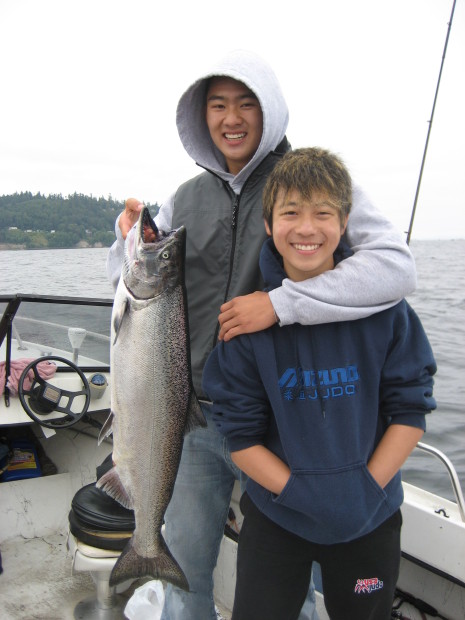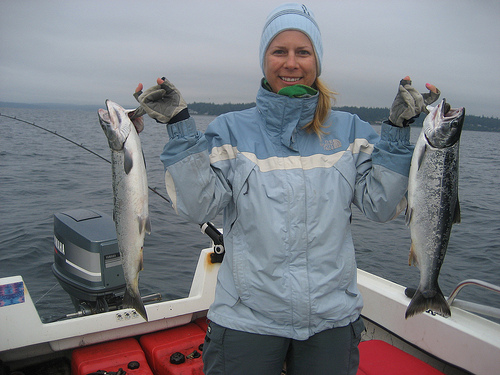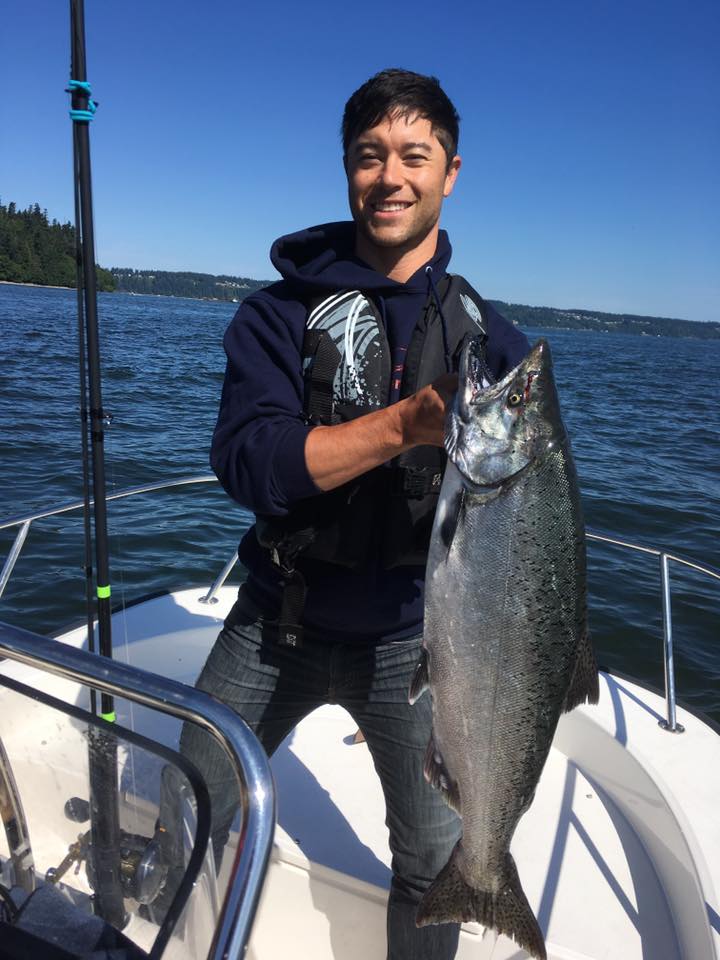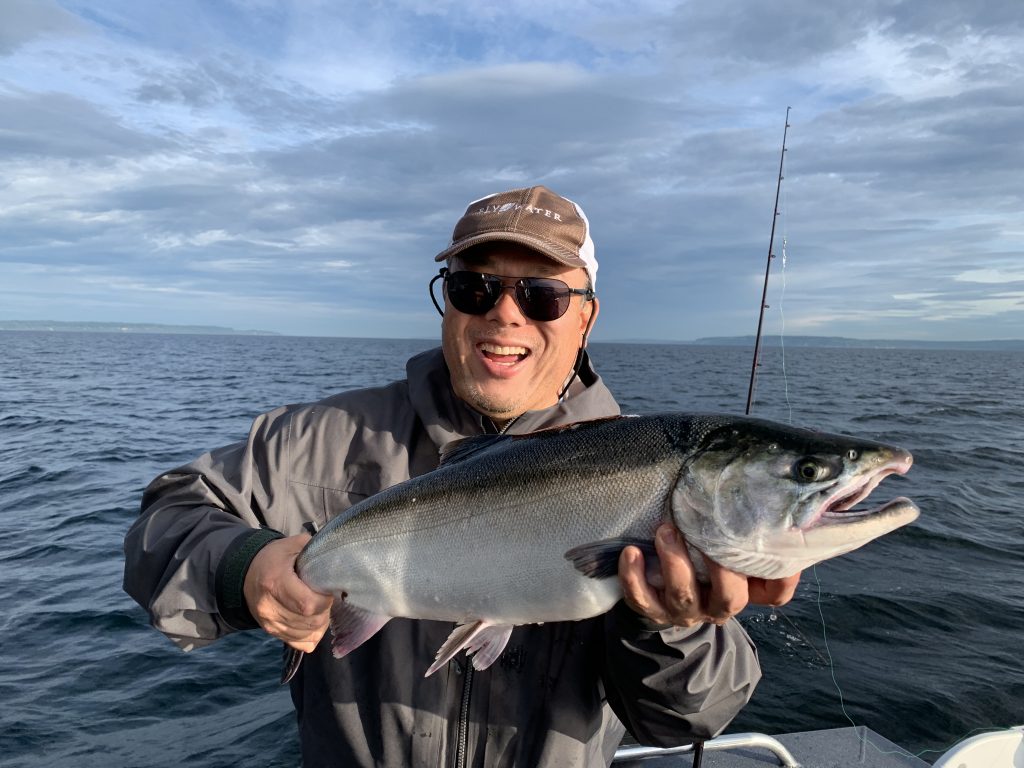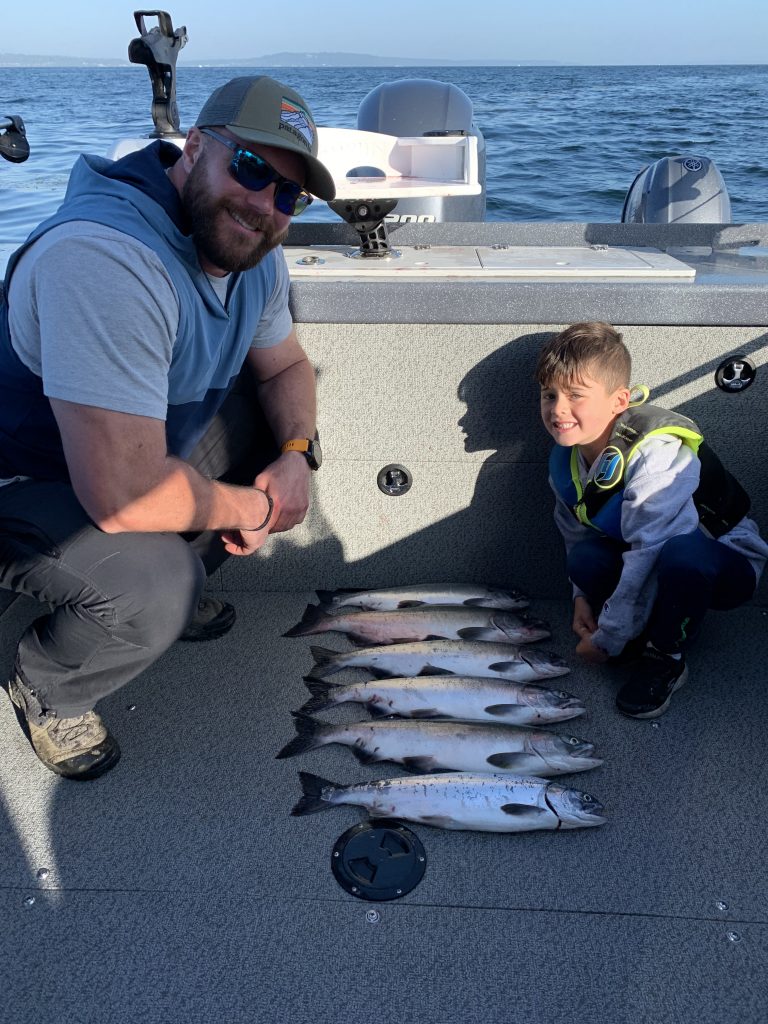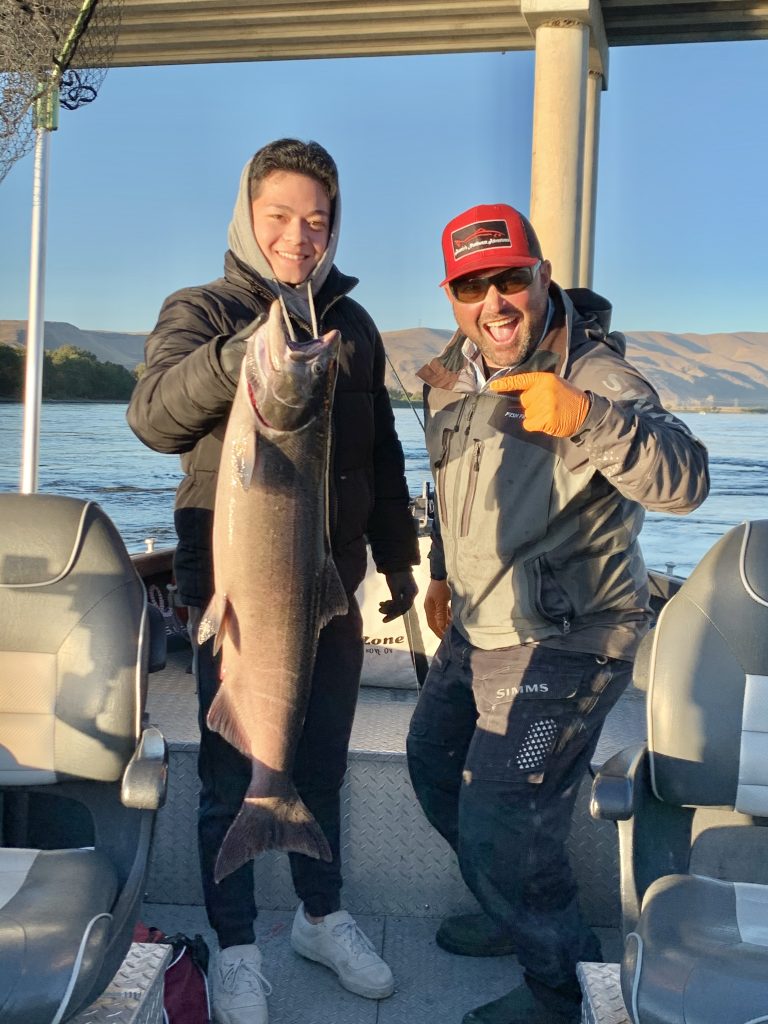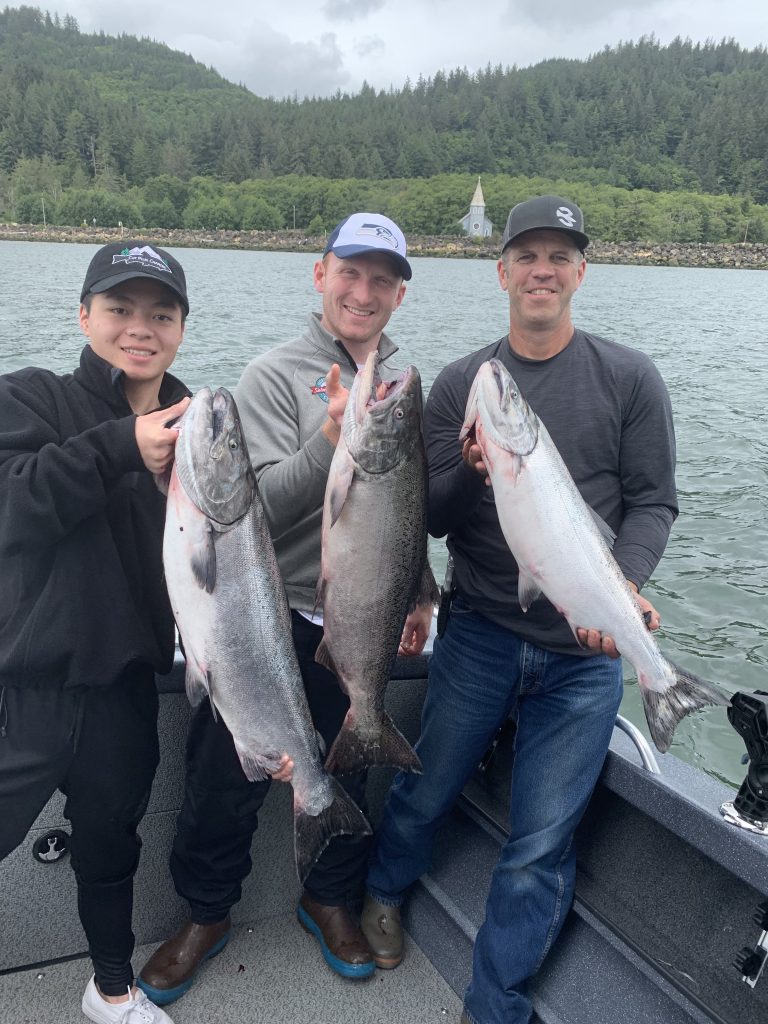

Sitka 2013: Huskies vs. Cougars!

Our annual Sitka “sojourn” took on a decidedly competitive theme this year.

Why?…Well, when you have a Husky and a Cougar on the boat, despite the fact they were Seattle Seahawk teammates… you’re going to have issues but, ..we’ll get back to that later.

Fortunately, catching fish would not be an issue this time. After over 20 years of experiencing the southeast Alaskan salmon stronghold that is Sitka, I am more than familiar with the annual variation in run timing and strength. So,I started to scratch my head a little bit when the Alaska Department of Fish and Game (ADF&G) issued their Chinook Abundance Index (CAI) for 2013 and it was a slightly low number (1.20). The cautious, conservative abundance estimate indicated some concern with northern British Columbia chinook survival but given strong forecasts to Washington and the Columbia river, I was betting on good action and, for once, I bet correctly!

The “competitors” on this trip would be my friend, former co-host of The Outdoor Line Washington State University and Seattle Seahawk center Robbie Tobeck and none other than ESPN’s  Brock Huard, University of Washington & Seattle Seahawk QB and now host of the Brock and Danny show on 710 ESPN Seattle. Brock’s busy career has kept him in the lower 48 and this would be his first trip to Alaska. He would not be disappointed.

First up on the rod was the “cantankerous Cougar” Robbie Tobeck. He is all smiles with this jumbo yelloweye rockfish.

Tobeck’s  career best 90 pound halibut didn’t hurt his feelings and took a little bit of the sting out of our annual Puget Sound halibut skunkings…

Robbie had to conduct some business in town after our morning bottomfish outing so after we got the fish cleaned and processed, we barely had time to pick up Brock and his friend Jamie Waltier from the airport for the afternoon salmon trip.

Brock had spent his morning broadcasting the “Brock and Danny Show” from the Seahawks minicamp where he interviewed Assistant Head Coach Tom Cable. When Brock mentioned to Cable that he was leaving directly for an Alaskan fishing trip,,,well,.. let’s just say that rabid fisherman and Snohomish, Washington native Tom Cable shifted the focus of the interview from free agents to fishing!

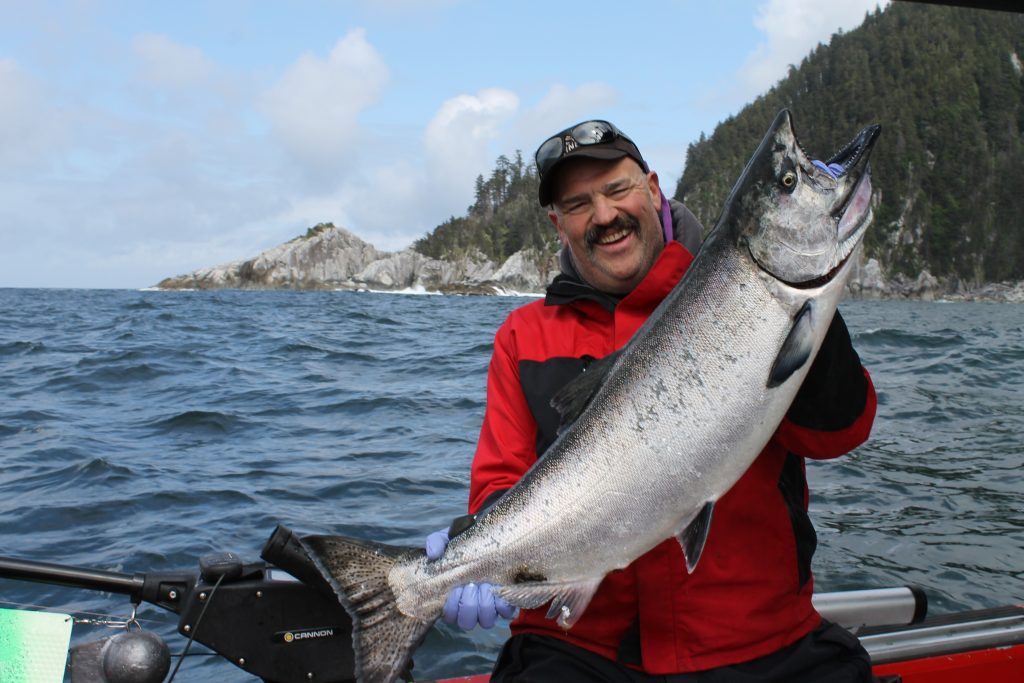
Brock Huard wasted no time getting his first Alaskan chinook on board! Despite a gusty first afternoon, he toughed it out and boated this chrome king.

Brock’s busy schedule allowed him only one salmon trip last year and it was a tough outing. So, when his first king hit, he was something way “north” of excited. In fact, this professional speaker, broadcaster and college football color commentator/analyst completely lost the ability to speak and spun the handle on my Daiwa Saltist faster than I thought humanly possible! Let’s just say that I’m glad we didn’t start him out on a single-action mooching reel…

With day one in the books, my good friend Derek Floyd of Reel Class Charters agreed to take us fishing on his day off. Here, Derek tells Brock’s friend Jamie Waltier what to expect aboard his 30 foot charter boat, the  “Angler”.

Holy smokes! Is that Brock playing a chinook with a single action reel? Absolutely! He is coachable after all!

Tobeck quickly got into the act as well. This 25 pounder got him all fired up and he started to realize that salmon are as least as feisty as his beloved tuna.

Brock Huard’s development as a salmon angler advanced from downrigger trolling with a levelwind to mooching with a single action reel and quickly progressed to successfully netting fish! Here Brock’s buddy Jamie is relieved to hoist the results of Brock’s first Alaska net job!

The biggest fish of the day aboard Derek Floyd’s boat was this fine 27 pounder. Counting coho, a couple chums and chinook, Derek got us into 40 salmon, displaying nothing short of a mastery of this fishery.

On our final day in Sitka, we wanted to get out after halibut just once more. Fresh from his successful netting experience, Brock wanted to give harpooning halibut a try. Here, “coach” Tobeck offers some advice.

Unfortunately, Huard could not overcome his coaching and failed to drive the harpoon through the halibut. Instead, this fish looked like he had just emerged from a tattoo and body piercing studio…

Fortunately, Brock’s prowess with a rod exceeds his, well, lack thereof with the harpoon. Here, Tom Nelson and Brock are all smiles with this 135 pound halibut.

Two long-time Puyallup friends with personal bests: Brock Huard (left) with his first-ever tyee (31 pounds) and Jamie Waltier with a fine mid-20′s chinook. Sitka’s scenic landmark volcano Mt. Edgecumbe looms in the background.

Our last day in Sitka was marked by unbelievable weather, Brock’s largest halibut, chinook and a salmon bite that had to be experienced to be believed. Here, the happy crew gets a chance to grin for the camera with the day’s catch.

Great trip, great weather, great friends and the fish cooperated every day. What more can a guy ask for? Summer fishing is off to a big, red hot start!

Tom Nelson
The Outdoor Line
710 ESPN Seattle

Dirty Downrigger Trick: Silver Horde’s Rudder Flasher!

Now that “seminar season” is begrudgingly giving way to fishing season, I’m looking back on the most frequently asked questions I’ve heard after my  “Dirty Downrigger Tricks” PowerPoint presentations.

I’m always looking for some new and interesting blog ideas and I believe a series of blogs answering these questions regarding controlled-depth trolling techniques may just be what the “downrigger Doctor” ordered!

One of the relatively recent additions to the downrigger fisherman’s attraction repertoire is the Silver Horde Rudder Flasher!

“We originally marketed it as a halibut spreader back in the mid 1970′s and by the late ’80′s some guys out of Edmonds started using them as rudders on their downriggers” said Silver Horde’s Kelly Morrison. Indeed, it is the “spreader effect” that is one of the most endearing qualities of the Rudder Flasher. As soon as it’s placed in the water, it immediately “weather vanes” or points behind the boat which allows you to easily reach your release -without untangling it- and quickly get your gear back to the fishes’ depth.

There are two ways to rig the Silver Horde Rudder Flasher: One, simply run your release directly off the back of the rudder…

…and two, running a “Dummy” or remote flasher off of the Rudder Flasher and then stacking your release a few feet up from the flasher!

By far the biggest advantage of the Silver Horde Rudder Flasher is it’s fish attraction characteristics. The Rudder Flasher affords your downrigger presentation a consistent horizontal profile which allows salmon to find your gear more easily. Simply stated, a rotating flasher makes noise and vibration in the water column but it’s continually moving, rolling aspect can often be a challenge for a salmon on the far reaches of the attraction threshhold to locate. The combination of a rotating flasher and a Rudder Flasher is a one, two salmon attracting “punch” that will result in more fish in your box!

Next time you’re out on your favorite trolling drag and you see someone land a fish, take a close look at what is running just on top of their cannon ball… The Silver Horde Rudder Flasher used to be the trollers secret handshake. Now, it’s more like the mark of the highliner fishermen.

Tom Nelson
The Outdoor Line
710 ESPN Seattle
www.theoutdoorline.com


Boat trailering: Cougar Style!

Meet Robert Lee Tobeck:

His resume is very impressive. Academic All American lineman at Washington State University, Pro Bowl center of the Seattle Seahawks during the highpoint of the franchise history: the 2006 Superbowl and former host of The Outdoor Line Radio Show.

Unfortunately, none of this tremendous life experience has prepared him for what has now become the greatest challenge of his life: Boattrailerautism.

Boattrailerautism or “BTA” is a fisherman’s developmental disorder that appears in the first 3 years of boat ownership and affects the brain’s normal development of mechanical, spacial and navigational skills. Most fishing buddies of the boattrailerautistic suspect that something is amiss when angry motorists pull up alongside, gesturing and yelling. In extreme cases of BTA, one may even observe the occurance of the dreaded “missing fender” syndrome.

Quite unfortunately, I was to bear witness to Tobeck’s latest BTA flare-up on what was to be merely a simple transducer installation. We met at his marina and due to high winds, Robbie was unable to get the boat on the trailer by himself so he requested my assistance and I was only too happy to help my friend out.

Tobeck’s trailer for his 30-foot Seaswirl Striper “Salmon Hawk” is a monster 5th wheel style extra heavy duty model with a “goose neck” design which requires the hitch to be placed directly above the rear axle to reduce tongue weight and increase trailer maneuverability.

While I remained ground level to crank the trailer up to above the ball height, Tobeck backed the truck up and then jumped in to hook up the lights, safety chains and secure the hitch…or so I thought…

We towed the empty trailer about 100 yards to the ramp and I jumped in Robbie’s boat to drive it on the trailer. Once the boat was secured to the trailer winch and cranked up tight, Tobeck returned to the truck. Little did we know that the unfortunate malady BTA was about to rear it’s ugly and mortifyingly embarrassing head.

I remained aboard as Robbie pulled the boat and trailer up the ramp. As the trailer started bearing the weight of the boat, I happened to be looking forward and BOOM!!! Simultaneously the trailer hitch jumped off the ball, landing in the bed of his truck as a geyser of Starbucks coffee hit the inside of Tobecks windshield.

Someone other than my friend Tobeck then emerged from the truck, hurling a blue streak of epithets and dripping with the remains of his mocha.

“Thank goodness for safety chains” was all I could utter as the bed of Tobeck’s new truck now appeared to be,…well… used.

As we cranked the tongue winch up, the hitch came up alright but the truck bed remained somewhat depressed.

Once we got the hitch back on the ball we found that Tobeck has a little bowl in the center of his truck bed that, once filled with rainwater, will be a handy and very mobile bird bath!

Always good natured -until he’s not- the Crimson Crusader takes his Boattrailerautism in stride and lets this latest “flare-up” roll off his back.

The rest of the morning and the transducer installation proceeded without incident. Heck, it could have been a lot worse….It could have been my fault!!!

Tom Nelson
The Outdoor Line
710 ESPN Seattle
www.theoutdoorline.com


Springer School!

Just as every northwesterner counts down the waning days of winter looking forward to spring, salmon anglers eagerly await the arrival of our earliest running chinook affectionately known as “springers”.

Trying to fit the four-hour springer sojurn to the Columbia into a busy schedule is challenging enough. Add to that the inconsistent, early season springer fishing reports and the term “forcing the issue” comes to mind.

After Saturday morning’s weekly installment of The Outdoor Line Radio Show and then the annual Master Marine Spring Seminar in Mt Vernon, “The Commish” Larry Carpenter and I hooked up to Big Red and did some I-5 time, launching in the Columbia just before dark.

A Columbia River Sunday morning sunrise greets us. We had great baits -and great attitudes- working early and late…


Unfortunately for us, despite great bait and a long effort, we would not get a single bite on Sunday. Mark Coleman of All Rivers Guide Service was the only guide boat we saw land a fish. Here is Mark and his happy clients with a springer right under the I-5 Bridge.


Enter my ol’ buddy Eric Linde for a little technique refresher… “springer school” if you will… Eric and his clients had a tough day on Sunday as well and since he didn’t have clients on Monday, he agreed to jump onboard Big Red for the Monday morning bite.


And yes,… true to form, on the second drag of the day Eric’s rod lit up and no matter how hard he tried to pass off the rod, no one would accept it! We “made” him play the fish!


I’m pretty sure there was no more experienced net man on the entire Columbia River that day than Larry Carpenter. Here he checks traffic ahead while he waits for Eric to get control of a hot springer.


Just one more run alongside the boat….


…and our first Columbia River springer of the season is in the bag!


Nothing quite says “chrome” like a St. Patty’s Day springer. Eric Linde’s smile says it all!


There are springers a lot bigger than this one, but what he lacks in size, he will more than make up in taste on the table tonight!!!


This year’s springer season is just getting cranked up. We’re guarenteed a season in the main stem of the Columbia through April 5th. After that, we’re at the mercy of an in-season update which may result in more days on the Columbia, but probably not until May. The Willamette, Wind and Drano Lake will remain open through April but keep in mind that until we see springer numbers over Bonneville in excess of 2000/day, the Bonne pool “bubble” fisheries will not be worth the drive.

Now, if you’ll excuse me… I have to put a springer on the “Bar-bie”

Tom Nelson

TheOutdoorLine.com

710 ESPN Seattle


The 2013 Salmon Forecasts!

A sure sign of spring after a long winter is the annual arrival of our salmon forecasts and the “North of Falcon” meetings. I await the salmon forecast numbers like a kid waiting for Christmas morning. Hello, my name is Tom and I am a “salmon sicko”.

After watching the numbers for a number of years (never mind how many…) I’ve found that you can “call some shots” by digging into the forecast numbers. The WDFW, DFO Canada and The PFMC (Pacific Fisheries Management Council) work very hard to get their chinook and coho abundance estimates out in a timely manner. These figures take some pouring through to find the real “meat” but don’t worry, I’ve done all the leg work for you right here!

2013 Preseason adult Chinook Forecasts (in thousands)

Stock                    2009       2010     2011_    _2012       2013
Willapa fall             34.8      31.1       36.8        45.2         27.1
Hoh fall                   2.6         3.3        2.9           2.7           3.1
Nooksack/Sam       23.0      30.3      37.5         44.0        46.5
Skagit summer       23.4      13.0      15.9          9.6         13.2
Stillaguamish          1.0        1.4         1.9          0.9           1.3
Snohomish Wild      8.4        9.9         7.4          2.8          3.6
Snohomish Hatch   4.9         5.6         5.1         3.9           6.8
Tulalip Bay              4.0         3.4         3.5        5.9          10.9
S Puget Wild          17.2      12.7        8.9          8.9           5.2
S Puget Hatch        93.0      97.4      118.6       95.8       101.9
Hood Canal Wild     2.5      2.4           2.1         2.9            3.3
Hood Canal Hatch  40.1     42.6         38.3       43.9         65.7
Key Stock totals 255,600  253,100  278,900  266,500  288,600

This is a very significant Puget Sound chinook forecast to say the least! Easily the highest number we’ve seen for over a decade.  We can be fairly safe in the assumption that chinook seasons may be similar to last year. Generally these selected stocks are up from 2012, most notably in the Skagit, Snohomish, Tulalip Bay and south Sound. However, on the coast Willapa is down sharply and the Nooksack/Samish checks in with a solid forecast as well which should drive a very strong Marine Area 7 summer chinook season.
.
The Silver Story! 2013 Preseason Adult Coho Forecasts (in thousands of fish)

Stock                     2009         2010            2011__ __2012        2013
Straits Wild              20.5          8.5              12.3           12.3       14.8
Straits Hatch            7.0            7.8              12.7           18.6       15.4
Nook/Sam W           7.0            9.6               29.5           25.2      45.4
Nook/Sam H          25.5          36.0               45.7           62.8      49.2
Skagit Wild             33.4          95.9             138.1          48.3     137.2
Skagit Hatch          11.7            9.5               16.2           14.9       16.3
Stilly Wild               13.4           25.9              66.5           45.5        33.1
Stilly hatch              0.0              5.4                0.6             4.1          3.1
Snohomish W         67.0           99.4            180.0         109.0     163.8
Snohomish H          53.6           24.5               8.4             8.5        12.6
S Sound W              53.6          25.3              98.9           43.1       36.0
S Sound H              188.8       186.4            173.3         162.9     150.9
Hood Wild                48.6          33.2              77.5           73.4       36.8
Hood Hatch              52.0          51.2              72.1           62.6       68.6
Key stocks Total   338,600   320,800      916,000   628,600     783,200


Bottom line: we should see a smokin’ coho fishery in Puget Sound this summer. The increase in Skagit stocks is almost double last year’s run and a look at the Snohomish numbers have me thinking that 2013 will not see many anglers stray far from Puget Sound come September! In fact, the overall feeling among fisheries managers is one of optimism bone of increasing oceanic salmonid survival.

Speaking of survival…. We can look for over 6 million pink salmon to stream into Puget Sound this summer as well!!! We’ll have a better breakdown of the “Humpy Hordes” coming to you in this blog in the very near future!

Keep in mind that these numbers are but the “raw material” that the co-managers will use to craft our local seasons and only by attending the North of Falcon meetings can you have an impact on the process. We will keep you posted here but I sincerely look forward to meeting some of you….at the meetings!!!

Tom Nelson
The Outdoor Line
710 ESPN Seattle
www.theoutdoorline.com

Cured Tiger Prawns for Steelhead

How many different colors can you make your Tiger Prawn? I guess the question should be, “How many different colors of Nectar does Pautzke’s actually produce”?

If you said 5, then you are on the right track. With that, we will stick with the basics just to make sense of it all. If I start mixing and matching colors, there is no limit as to how lengthy this article could end up. With 5 Nectar colors to choose from, you could actually create what I refer to as the Tiger Prawn Rainbow…

Now to say that Pautzke’s Nectar will add some color to your Tiger Prawn, is an understatement. The colors are very vibrant and basically jump off the page at you. Nectar not only adds tremendous color to your Prawn, but also additional bite stimulants that you get just as a result of how the Nectar is produced. You are essentially soaking your Prawn in Egg Juice, which adds additional scents and attractants, Oh and by the way, did I mention COLOR…

Another question to ponder, Are you using Tiger Prawn for Salmon and Steelhead? If not, then How Come? Ok, I guess that is actually two questions.

If you have sat through any of my shrimp Curing Seminars, Coon Shrimp, Tiger Prawn etc. then you have heard me talk about the versatility of these baits and just how much you can do with them.

The first thing I like to remind folks is that fish, absolutely love them. They are a very natural smelling and looking bait that fish very well raw with a little salt and sugar.

Now we are going back into the Bait Lab to take our beloved Tiger Prawn to the next level. For me at different times of the year, adding color to my Tiger Prawn is great way of creating multiple baits and giving me multiple options from just one simple bait.

I can also create two different baits using just one color of Nectar. If I soak my Tiger Prawn, for example in Blue Nectar, it will turn my Prawn, very, very Blue. An option that I like to use more than not, is simply this. Some of the Prawn are soaked with the shells peeled off and some are soaked with the shell left intact.

For the Prawn that are soaked in the Nectar with the shells removed, you will notice the color penetrates the Prawn completely and makes all of the Prawn Meat a very bold color based on the color you have selected.

For the Prawn that I soak with the shells In-Tact, the Nectar color of choice penetrates the Prawn Meat around the edges, leaving the center of the Prawn almost a natural color or just slightly colored by the Nectar. For me this creates a bait with “Color Contrast” which at times, may be just the difference needed to stimulate a bite.

Now, past practice for many is to chunk cut your Prawn and use it while side drifting, drift fishing and or even tip a jig with it every now and again.

For me, as I have mentioned before, chunk cutting is ok, however I like to change it up a bit and fish bait that has a little more natural action. I find that by simply cutting your prawn length-ways, down the center of the back, you end up with a very nice thin Prawn Fillet. This will fish very well when side drifting or drift fishing, it will also fish very well under a float. The thinness of the fillet allows the bait to tumble and role and in some respects float naturally, to more so resemble natural bait then just a chunk of meat tumbling along.

How about to tip a jig? Have you ever strip-cut your Prawn.

Once you have mastered the skill of cutting your Prawn Baits into nice even Prawn Fillets, the next step is to cut them once again, length-wise, to create a nice long strip of Prawn that resembles a very small worm. We know that pink worms and actually multiple colors of worms have become very popular for fishing Steelhead and Coho. Why not create your own colored mini-worm that has great scent properties, and when tipped on a jig actually has the added bonus of action. You cannot get that by simply putting a chunk of Prawn on your jig hook.

Using Pautzke’s Nectar is a great means of adding tremendous color and scent to your Tiger Prawn. To get your Prawn to fish the very best that they can, you still need to add a little more to create the ideal cure.

A basic recipe I like to use is simply this:

One Bottle of Pautzke’s Nectar (any color)
1/4 cup Non-Iodized Sea Salt
1/2 cup Sugar, (White or Natural)

That’s all there is to it, really it is just that simple. If you are curing Tiger Prawn for Salmon a 1/4 cup of Salt and just a 1/4 cup of sugar will do just fine. For Steelhead, I like to sweeten them up a bit and will add the extra sugar, as much as a 1/2 cup. This can actually cure up to about 25 Tiger Prawn, in the 51 to 60 count size.

I will generally soak Tiger Prawn for about 24 hrs. in my colored cure mixture and then they are ready to fish. The Pautzke’s Nectar adds the color and bite enhancements and the salt and sugars add the sweetness and durability I can depend on that makes these little baits fish so good.

I will fish them right out of the soaking container the first trip out and cut as I go. If I have some left over and plan to fish within the next week or two, I can take the Tiger Prawn out of the cure and place them into a tupperware container and store them in my bait fridge. Just for test purposes I have had Tiger Prawn cured in this exact recipe last in my bait fridge for up to four months and still fish very well.

Which color of Nectar you choose is entirely up to you. I will however let you in on one additional secret. If you do select the Red or Yellow Nectar, you will also be adding UV to your Tiger Prawn, which may just be the difference you are looking for, when fishing low light or off colored water conditions.

Duane Inglin
The Outdoor Line
710 ESPN Seattle
www.theoutdoorline.com

Northwest Outdoor Report

First Razor Dig of 2013 Scheduled

WDFW just approved the first razor clam dig of 2013, starting Tuesday (Jan. 8) at Twin Harbors and expanding to include Long Beach, Mocrocks, and Copalis beaches later in the week. Twin Harbors will be open from January 8th thru January 14th and Long Beach, Mocrocks, and Copalis Beaches will be open Thursday January 10th thru Saturday January 12th.
Commission to Consider Removing Gillnets from Columbia Mainstem
The Washington Fish and Wildlife Commission will meet January 11th and 12th in Olympia to consider shifting gillnets off the mainstem of the lower Columbia River and into designated off-channel fishing areas. The plan would also shift allocation on many of the Columbia’s salmon runs over to the recreational sector. The Oregon Fish and Wildlife Commission voted 4-2 back on December 7th to adopt the plan and now it’s up to their counterparts in Washington to move the plan forward. The meeting will be held in the Columbia Room of the state Legislative Building starting at 8:30 a.m..

Brant Hunt Approved for Skagit County

A flight by wildlife biologists last week determined that brant numbers would support an 8 day hunt in Skagit County. At least 6,000 birds are needed to support a hunt and wildlife biologist Don Kraege counted 8,960 brant in Fidalgo, Padilla, and Samish Bays. The hunt is scheduled for January 12, 13, 16, 19, 20, 23, 26, and 27. Be sure to check out the WDFW website for more details on this special brant hunt, as there are special license requirements in place.

Wild Steelhead Showing Early in the Skagit

John Koenig of Johns Guide Service (360-708-3166) in Rockport reports catchable numbers of wild steelhead in the Skagit River right now. He’s been surprised by the number of wild fish this early in the season and thinks that the Skagit could be in store for some excellent fishing in late January and February when the wild steelhead show up in earnest. In stark contrast the hatchery steelhead return on the Skagit has been so poor that the Cascade River was recently closed down so that the Marblemount Hatchery could meet its egg take goals.

Sol Duc Fishing Well

Mike Zavadlov from Mike Z’s Guide Service (360-640-8109) in Forks has been seeing really good numbers of wild steelhead in the Sol Duc already. Mike’s caught steelhead into the low teens, as well as a few Snider Creek steelhead. One of Mike’s go-to jigs lately in the low and clear water has been a pink and purple Beau Mac 1/8th ounce jig. While the Snider Creek broodstock program was discontinued last year, anglers can still expect to catch those fish for at two more years on the Sol Duc River.

Potholes Spotty for Ducks, Good for Geese

Levi Meseberg from Mar Don Resort on Potholes Reservoir reports great goose hunting over the Christmas break with limits or near limits of geese for the last couple of weeks. He says the cold weather that’s made the goose hunting so good has pushed a lot of the ducks south though. While there’s been a few pockets of birds around he says the duck hunting hasn’t been all that great lately. With temperatures forecast into the mid-40’s for the Potholes region next week he thinks the duck hunting could be some of the best of the season. Waterfowl season will close on January 27th this year, so duck hunters have just a few more weeks to get their hunting in.

Kent Man Attacked by Coyotes

When Faron Scarberry moved to Kent two weeks ago he had no idea how dangerous going for a walk with his dogs might be. Last Friday night while he was walking his dogs three coyotes attacked him in back yard. They initially went for Scarberry’s face and he was able to block them, but one of the coyotes grabbed him by the leg. He was able to ward off the coyotes, but he still spent the night in the emergency room and got 24 rabies shots on his leg and hip. Coyotes rarely attack humans, but wildlife officials recommend keeping garbage contained and pets inside at night this time of year to reduce the chance of an encounter.

Gun Map Backfires on New York Publisher

When the Journal News in New York recently published a story called “The gun owner next door: What you don’t know about the weapons in your neighborhood” burglars and crooks immediately took notice. Along with the story was a map of every gun owner in Westchester, Rockland, and Putnam Counties. While the intent of the insanely stupid article was to “out” local gun owners the article did nothing but help crooks and enrage gun owners. Burglars who needed guns now knew which homes to hit and the information also let burglars know which homes were gun-free and easy to rob. One blogger reacted by posting a map showing where key editorial staffer live. Outraged groups have called for a boycott of Gannett Publishing’s advertisers and the newspaper now has armed guards stationed outside at least one of its offices.

Rob Endsley
The Outdoor Line
710 ESPN Seattle
www.theoutdoorline.com

The Ultimate Steelhead Rag

Fishing rags for steelhead has actually been around longer then I have been fishing. A few guys have told me they were fishing rags back in the 1960’s.

My Dad started fishing rags on the Puyallup and Carbon Rivers back in the eighty’s. I’m not sure where he saw it, or came up with it, but it was a styrofoam and yarn combination that he swore by.

At some point, backer-rod was the simple go-to method to create the rag body. One cut and you had a nice small piece of foam to pull the yarn through.

Today, and for quite some time now you can find rags tied on leaders, packaged and sold in sporting good stores pretty much everywhere. Most of the manufactured rags are white-bodied and usually have one or two colors of yarn pulled through them.

I gave up on trying to find backer-rod about ten years ago. Walking through Target one summer I stopped in the toy section and stood and stared at the big box filled with pool noodles. There were about six different colors in the box but the colors that caught my attention were the orange, pink, and chartreuse/green noodles.

I figured colored foam…how could this not work? I’ve also experimented over the years with any type of colored foam I could get my hands on. Some are tough and spongy while others are light and brittle. You won’t know if it will work until you cut a piece of foam and then try to pull yarn through it.

Colored rag bodies just make too much sense. Over the years, I have found that they work great for both steelhead and salmon. I pretty much rely on the pink and orange for steelies though. I use green or pink for Salmon. When I say salmon I can honestly say that I have caught, kings, coho and chums on “Rags & Eggs”.

The other key component in your rag construction is the yarn. I use a lot of the Glo Bug Yarn. They have so many colors to choose from, it’s durable, and they now have a lot of colors in UV.

When it comes to steelhead I think color selection is key. Even though Dad, back in the day, would use white backer rod he would use anywhere from four to six different colors of yarn when he would make his rags. The key to his success was the color contrast and not much has changed in 40 years of steelheading.

Steelhead are very visually stimulated. Light and dark colors in combination create contrast that they pick up on. It also grabs their attention when color combinations replicate natural food that they feed on.

Think about the different colors in a Sand-Shrimp. Pinks, orange, purples, perhaps a little black, and the guts inside a sand shrimp are a brighter yellow color. Those are pretty much the basic go-to colors for my steelhead rags.

I will mix in some steelhead peach or at times a brighter pink or cerise. Usually I use a maximum of six colors with a single dark color mixed with two lighter colors in each combination. For me it’s all about the creating contrast.

Due to the large diameter of the Glo Bug yarn I will cut it to length and then separate each piece length wise to make it thinner. To try and pull a full size piece of the yarn through the foam and you’ll find that it’s just a little too thick.

To create or punch out the rag body it’s really pretty simple. First take your pool noodle and cross cut off a disc or round. The wider you make the disk you cut off, the longer your rag body will be.

Next take a three to four inch piece of copper 3/8th in. water pipe. Take a small file and sharpen one end of the pipe, inside and out, until you get a sharp edge. When pushing the sharpened end of the tool against the foam and slightly twisting it back and forth, it will cut right through the foam. Using a pencil to push the cut plug of foam out of the tool works well.

Next, grab one of your yarn color combinations and pull it through the foam. This is easy to do with a needle and a piece of braided fishing line tied in a loop. Something else that works really well for pulling yarn through the foam is a fly bobbin threader. Push the threader through the foam, place one end of the yarn pieces into the threader and pull it back through the foam.

I pull the first three pieces of yarn through the foam. With the three short pieces laid together you can easily pull it through the foam as long as you grab the very end of the yarn in your loop. The more the yarn doubles back on it’s self in the loop of braid the bulkier it is and the tougher it is to pull through the foam.

When I push the needle through for the second yarn grouping I place it in the foam just below the first layer of yarn. I don’t want to try to pull yarn through yarn because it won’t work.

Once I have both sets of yarn pulled through I’ll pull and separate the pieces of yarn and spread them out around the body of the foam. Then I’ll cut and trim the yarn to length.

The final step is to simply tie your leader and thread the rag on to it. Push the needle through the body of the rag from bottom to top. Make sure you put a bead above your hook before threading on the rag. This helps to keep the eye of the hook from punching up into your rag. Without the bead you’ll go through a lot of rags in a day because the hook will tear up the foam.

Tie yourself a leader roll full of rags and go chase some winter steelies. Eggs and rags or rags with sand-shrimp tails are both hard combinations to beat. For me, float-doggin rags with bait in steelie-green water conditions is a definite go-to…

Duane Inglin
710 ESPN Seattle
The Outdoor Line
www.theoutdoorline.com


Northwest Outdoor Report

Clam Dig Next Weekend
WDFW just announced another razor clam dig next week. Twin Harbors beach will be open Tuesday thru Saturday, and on Thursday Long Beach will open up and over the weekend Long Beach, Twin Harbors, Copalis, and Mocrocks beaches will all be open for razor clamming. Clamming generally starts two hours before the low tide in the evening.

Black Friday Trout Fishing Special
If you’d rather go fishing than shopping the day after Thanksgiving then WDFW has the deal for you. They’ll be planting Battleground Lake and Klineline Pond in Clark County, Kress Lake in Cowlitz County, Fort Borst Park Pond and South Lewis County Park Pond in Lewis County, and Rowland Lake in Klickitat County with 2,000 rainbows apiece. Chris Donley from WDFW called the Black Friday fishery an experiment that could lead to similar events in other parts of the state.

Southwest Washington Elk Opener Toughest in Years
Mike Jenkins from Upfront Outfitters (360-560-7620) said that fog descended on his camps in Southwest Washington just in time for the elk opener. He said the fog spotting elk nearly impossible and that the success rate for the entire area hit an all time low. The upside is that the last part of the season could be very good for elk hunters, since there’s a bunch of bulls still out there and hunter numbers are generally low the latter part of the season. Jenkins thinks the drop in temperature this week could make hunting very good!

Silvers Piling into the Humptulips
Scott Sypher from Canyon Man’s Guide Service (206-518-4982) is reporting wide open coho fishing out on the Humptulips the last few days. He limited out his customers quickly Thursday morning throwing #4 and #5 hoochie spinners into the lumber. Sypher says that gold and copper spinners seemed to be the best color. The Humptulips has a 3 fish daily limit for silvers this fall, only one of which can be a wild coho.

Ranker Digging into Wolf Pack Removal
Senator Kevin Ranker from Friday Harbor, who chairs a committee that oversees WDFW, says he’s going to hold a hearing about the department’s decision to remove the Wedge wolf pack in Northeast Washington last month. The wedge wolf pack had killed two cattle and injured 15 others on the Diamond M ranch north of Colville before the department made the decision to remove the pack. He thinks officials and the rancher could have done more to deter the wolves from attacking cattle. While he won’t be asking for resignations or reprimands, he will be using the hearing to more clearly clarify the states position on wolf removal and make sure this doesn’t happen again.

Pikeminnow Angler earns 77,000
Portland angler Nikolay Zaremskiy earned $77, 238 last year catching pikeminnows from the Columbia River. The state has a bounty on the pikeminnow in the Columbia, which has a voracious appetite for salmon and steelhead smolts. It’s the second year in a row that Zaremskiy has earned over $70,000 dollars catching pikeminnows. Last year he earned over $71,000 dollars. Eric Winther, who manages the program, called him the Michael Jordan of pikeminnow fishing. The bounty program starts in early May and runs thru September and last year it dished out over one million in rewards.

Rob Endsley
The Outdoor Line
710 ESPN Seattle
www.theoutdoorline.com

Do you have “The NAK” for fishing

I’m often asked which scents I use. And, while there are many options available, most of the time, I use three: Pautzke Nectar, anise and krill. These scents, when combined and mixed properly, make a difference. Nectar, Anise, Krill or “NAK”, as I call it, is the additive I rely on for Northwest salmon and steelhead fishing.

Let me explain how to use these scents to your benefit. Nectar is only found in the Pautzke line up. For those who are not familiar with this product, you’re missing out. Nectar is created when the factory is cooking Balls O’ Fire salmon eggs. In essence, it’s the run-off of all that egg juice, salts, sugar and additives, which are drained into large vats and bottled.

Bottled salmon egg juice is your friend. It comes in five colors. However, for fall salmon red is my favorite. I also invest in krill, the liquid form (Liquid Krill) and powder form (Fire Power).
To create “NAK” for steelhead the first thing I do is pour a small amount of Nectar out of the bottle to make room for the krill and anise. (Only pour a little out, keeping the level to the top of the label). Then pour half a bottle of Liquid Krill and one heaping tablespoon of Fire Power.

With Nectar and krill mixed in, it’s time to add anise. I purchase 100% pure anise and add 10-15 drops. That’s it: simple and effective. With this mixture it’s best to pour some in a small container and dip your baits in it every few casts.

For salmon it’s important to add a half-teaspoon of sodium sulfite. However, when fishing an area where salmon respond better to a higher percentage of sulfites I add a full teaspoon.

Normally, I carry three bottles of NAK: one of the basic mixture (the steelhead version), one with a half teaspoon of sodium sulfite and one with a full teaspoon. It’s best to let the fish tell me what they want.

To dress up my eggs by giving them extra scent and milking ability I cut pieces of roe and place them in a separate tray adding a shot of NAK on some of them. Traditionally, I won’t do a whole skein if I think there is a chance that the fish may not respond. Once I add it, the skein has the scent/additives and if it doesn’t work I’m stuck fishing eggs that the fish don’t want.

One other tip; don’t be afraid to give your sand-shrimp a quick squirt. You’ll be surprised with the results. Give NAK a try. You’ll be glad you put in the extra effort.

Duane Inglin
The Outdoor Line
710 ESPN Seattle
www.theoutdoorline.com