
Northwest Outdoor Report

New State Record Lake Trout Caught
Phil Colyar from Wenatchee just caught the new state record Mackinaw trout from Lake Chelan on Monday. The huge lake trout weighed 35 pounds, 10 ounces and beat the old state record by just 3 ounces. Colyar caught the fish in 270 feet of water in front of Kelly’s Resort on the south shore of Lake Chelan. After a 35 minute battle he and fishing buddy Jack Stagge raced to the nearby hospital in Chelan, which happened to have the only certified scale in the area. Colyar, Stagge, doctors, and nurses all watched as the scale ticked up to 35 pounds, 10 ounces. Colyar is having the fish mounted and plans to keep fishing for big Mackinaw’s in Lake Chelan, as he thinks there’s even larger Mackinaw to be caught in the lake.

American Lake Still Kicking Out Rainbows
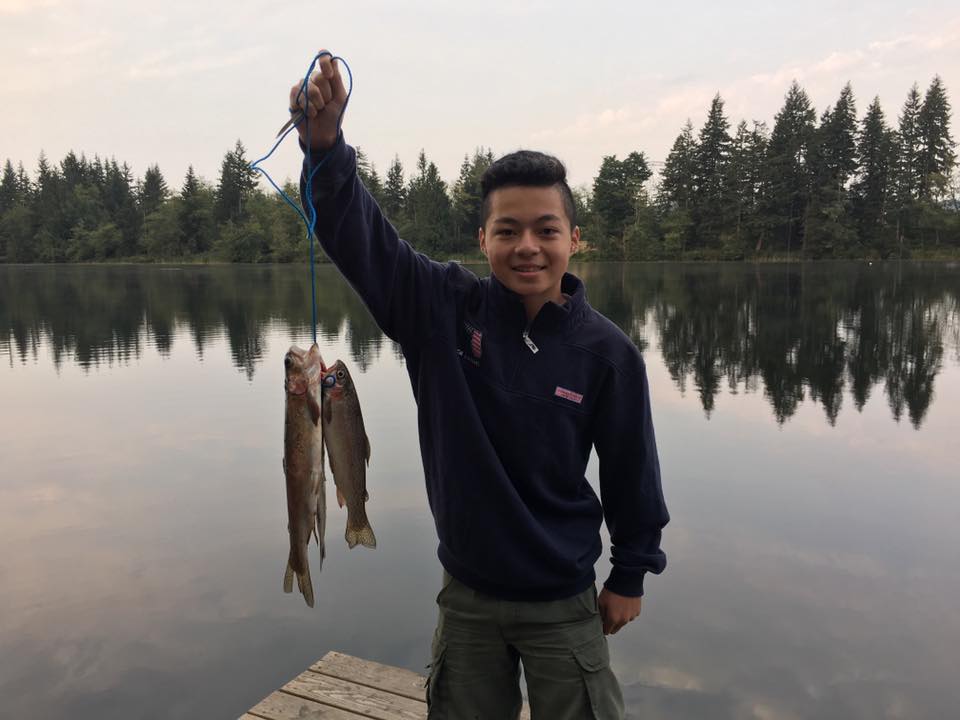
Mike Barr from Bill’s Boathouse on American Lake says that anglers are still getting limits of nice trout fishing off the of the boathouse dock. He says a bunch of small trout in the 7 to 9 inch range just showed up, but the people that are putting in some time are going home with limits of trout in the 13 to 15 inch range. He recommends fishing yellow or lime green Power Eggs on the bottom in 12 to 35 feet of water. Barr says there’s definitely no shortage of trout in American Lake.

First Springer Caught on the Cowlitz
Todd Daniels from Tall Tails Guide Service knows of at least five spring Chinook being caught on the lower Cowlitz River this past week. Daniels says the springers have been caught in the Castlerock area and he knows that at least one of them hit a Kwikfish. There’s been sporadic reports of spring Chinook being caught on the Kalama River, as well. The forecast for both rivers is down this year with only 5,500 springer’s projected for the Cowlitz and just 700 spring Chinook projected for the Kalama River.

“Uncle Pete” Leading in the Roche Harbor Derby
After day one of the Roche Harbor Derby “Uncle” Pete Nelson is leading the derby board with a 16.7 pound blackmouth. Carter Whalen is in a very close second place with a 16.4 pound blackmouth and Derek Floyd and company are leading in the total weight category with 46 pounds 3 ounces. There’s still one more day to go in the two day derby and we’ll have more coverage and the final list of winners available on TheOutdoorLine.com.

Oly-Pen Salmon Derby Offers $22,000 in Cash
Tickets are on sale now for the Olympic Peninsula Salmon Derby happening February 16-18. The derby area extends from Freshwater Bay all the way to Port Ludlow and includes the banks in the Strait of Juan De Fuca and the western shore of Whidbey Island. Derby weigh stations are located at Freshwater Bay, Port Angeles, Sequim, Gardiner, and Port Townsend. Tickets are $40 apiece and derby chairman Dan Tatum expects well over 1,000 anglers to fish in the event, which boasts $22,000 in cash and prizes. John Otness from Tacoma won the event last year with a 17.60 pound blackmouth. The Outdoor Line will be fishing in the event and broadcasting live from Port Townsend next Saturday. For more information log onto GardinerSalmonDerby.org.

Hood Canal Derby Next Weekend
Tickets are on sale for the Bill Nik Memorial Derby next Saturday at Misery Point boat launch. The derby is ran by the Kitsap Poggie Club and boasts $2000 in cash and a ton of prizes. Last year’s derby was won by Shane Morrison with a 13.6 pound blackmouth he plucked from Hood Canal. Tickets are available at Kitsap Marina, Defiane Marine, Aqua Tech Marine, Brother Dons, Seabeck General Store, Papas Eats and Treats in Port Orchard, and Camp Union Saloon in Seabeck.

Maine Legislators Out to Ban Swim Baits
KeepAmericaFishing.org is reporting that legislators in Maine just introduced a bill that would prohibit the use of all “rubber” lures. The intent of the bill is to ban the soft plastic swim baits that most Maine anglers use every day. The bill would also ban the use of biodegradable swim baits, as well. Extensive tests have proven that plastic baits cause minimal problems for fish and they usually regurgitate them or pass them without problems.

REI Executive Named Secretary of the Interior
The Associated Press is reporting that President Obama just nominated REI’s Chief Executive Officer Sally Jewell as the new Interior Secretary. Jewell has helped push REI to nearly 2 billion in annual revenues and a place on Fortune Magazine’s “Best Places to Work”. The Interior Department manages more than 500 million acres in national parks and other public lands and more than 1 billion acres offshore. If confirmed by the Senate Jewell will replace current Interior Secretary Ken Salazar, who has announced he will step down in March.

Rob Endsley
The Outdoor Line
710 ESPN Seattle
www.theoutdoorline.com

Northwest Outdoor Report

Humptulips and Satsop Kicking out Coho
Patient anglers that waited until the end of the season to fill their freezers with coho were rewarded with great fishing this past week on the Humptulips and Satsop Rivers. Scott Sypher from Canyon Man’s Guide Service (206-518-4982) and Phil Stephens from Mystical Legends Guide Service (206-940-0052) both reported excellent silver fishing on both rivers. They both got quick limits on the Humptulips fishing eggs under a float two days ago and the fish have been big…running between 10 and 15 pounds. Over on the Satsop several fish in the 18 to 20 pound range have been reported the last couple of days, as well. These fish are often called the Christmas coho because the fishing usually remains good right up until Santa Claus rolls into town. The only problem is that the Northwest River Forecast Center is predicting that these rivers will be well out of fishable shape until as late as next weekend.

Cowlitz Slow for Steelhead
Outside of just a few winter steelhead being caught on the Cowlitz River fishing has been really slow there this past week. Derek Anderson from Screamin’ Reels Guide Service (206-849-2574) thinks the next high water should bring some fish into the system in the next week or so. The Northwest River Forecast Center is calling for the Cowlitz to ramp up to over 16,000 cfs by mid next week after a series of wet weather systems hits Western Washington, which is much too high to effectively fish for steelhead.

Blackmouth Still Holding off South Whidbey
When the weather allows for it Derek Floyd from Angler’s Choice Charters (425-239-5740) has been stroking the blackmouth at Possession Bar off the South end of Whidbey Island. Derek said he landed 13 legal blackmouth last Saturday on the bar and released another 5 wild fish before calling it a day. Floyd said it’s been tough to fish lately with all the wind, but when it lay’s he thinks the fishing will remain good. The Floyd fishing team will be heading to Friday Harbor the middle of this next week to compete with 70 other fishing teams and $15,000 in cash prizes in the Resurrection Salmon Derby.

Gillnet Removal on Tap for Columbia River
Sportsman may soon get their wish to have non-tribal gillnets removed entirely from the lower Columbia River. The Oregon and Washington Fish and Wildlife Commissions will meet at the Holiday Inn in Portland on December 7th and on January 11th and 12th in Olympia to vote on a plan to push gillnets off the mainstem of the lower Columbia and into designated off-channel netting areas. If the plan goes thru the sportfishing quota on runs like summer Chinook would be increase to 100% of the non-tribal catch. Sportsman would also see an increase in spring Chinook, fall Chinook, coho, and sockeye quota if the plan is approved. While the plan is very complicated many are hopeful that the gillnets will be removed and that a new era in sportfishing will dawn on the Columbia River.

Resurrection and Roche Harbor Derby Tickets on Sale
Tickets are still on sale for the Resurrection Blackmouth Derby in Friday Harbor next weekend. The Outdoor Line crew will be fishing in this derby and broadcasting live from the derby on Saturday. The derby is December 7th and 8th and boasts $15,000 in cash with $10,000 for 1st place. Log on to www.resurrectionderby.com for more information about this event. The next  big derby in the series is the Roche Harbor Derby held February 7th thru the 9th at Roche Harbor on San Juan Island. The Roche boasts $25,000 in guaranteed cash prizes and this year the resort will kick in an additional $30,000 for a winning blackmouth over 30 pounds. Tickets are $700 per boat for the Roche and registration forms can be found at www.rocheharbor.com.

Arizona Fish and Game Corrects False Press Release
Television, radio, newspaper and online news outlets carried a story this past week that elk hunters who hadn’t filled their bull elk tag at the end of the season would get a weeklong extension to their season. The Associated Press released the article without checking credentials and now Arizona Fish and Game officials are scurrying to clarify the situation. Officials aren’t quite sure where the press release came from, but suspect that an elk hunter with media access is behind the hoax.

Rob Endsley
The Outdoor Line
710 ESPN Seattle
www.theoutdoorline.com

Sunshine and Springers

Sunshine and Springers

About a half hour ago, my wife Sheri proclaims as she walked through her kitchen, "this house smells like fish". Yes honey, yes it does. It's that damn Chinook, I can't help it, if it's a Fall fish or Spring Chinook, there is that distinctive smell. I guess all things considered, that's a good thing.


Last night while on the phone with my good buddy Darren Hoberg,  Co-Owner and Guide for Team Great NW Rivers Guide Service,
www.greatnwriversguideservice.com the discussion was Cowlitz for steelies or back to the Big-C for Springer's. In Darren's words, they are starting to show. So that was that and I would be getting up at 03:00hrs. so myself and the Kokanee Dominator could meet Darren at the Willow Grove boat ramp on the Big C. 


So here we go, the weather forecast was favorable, the tide was perfect and it was a short twenty minute ride to the location at which we would spend our day on "Da Hook".


The day starts out with the sun coming up and showing me once again, the added bonus of a day spent on the water. For all of those who never get a chance to be outdoors and enjoy what nature has to offer, I feel sorry for you. Once in a while, you just need to stop and take it all in.


And sometimes it's the little things you notice when you're out fishing and just happen to have the camera. It can be something as simple as boat light reflection, go figure.


OK, enough of the fluff, let's get right to it. 


So you wanna go Springer fishing. If you are not on the troll and get settled in on "Da Hook", this is how your day starts.  


Then it's simply a waiting game. Waiting for the tide to push fish in. Waiting for fish to show and then hopefully waiting for the fish that show to be willing participants in this game of hook and retention.


Well, the fish did in fact show.


Actually throughout the morning, we had a lot of consistent activity on the Lowrance screen. With three rods deployed, surely we would have some willing participants. The rigging of choice, plugs of course. Meat wrapped plugs on a four oz. sinker/dropper with about a four ft. leader. The choice of plugs, that was easy. For Darren, Kwik Fish, for me, Mag Lips. I was also using some meat wrapped on my plug that I decided to try for the first time. This wrapped bait had been soaked in Pautzke's chartreuse Fire Brine, then cut to size and wrapped on plugs. I'll do a complete blog next week on how to create fantastic UV, on your bait wraps for your plugs when fishing dirty water. Oh, that's right; I failed to mention the dirty water. I would say with full sun up and light penetration we had a solid two feet of vis. So UV, you bet.


Finally, about an hour into the morning an aggressive take-down on the UV Mag Lip with meat. An aggressive take however, a non-stick. Ok, at least it's a start and we have a good number of fish swimming by it would be nice to hook a few.


One thing worth mentioning; when you have fish on the move and you know they are there, this is not the time to be lazy with your offering in the water. Switching out your selection about every 20 minutes or so with a fresh wrap of meat is advised. Strong scent and oils, in the dirty water accompanied by the action of a good UV plug can make all the difference in having a successful day.


Case-in-point; a fresh meat wrap on the plug that was hammered 30 minutes prior and not more then 5 minutes in the water, produced an aggressive take down which resulted in that whole retention thing I mentioned earlier.


Not a monster, but a hatchery fish, non-the-less.


So the patience and persistence pays off. The sun was up, the water was calm and we were kept awake by the periodic visitor, giving us an impressive tug-down on our offerings. Five in all, however, we were only fortunate enough to have one stick solid enough to bring to the net.


Let me spell it out for ya, yes the hooks were sharp, no we didn't have premature-rod-jaculation, yes the rod tip was buried in the water at the time of hook set. What could it possibly be??? I'll tell you exactly what it was, "A beautiful day of Springer Fishing"  


Duane Inglin
The Outdoor Line
710 ESPN Seattle
www.theoutdoorline.com

Fire Brine For “Tributary Springer’s”

Fire Brine For “Tributary Springer’s”

Early in our winter steelhead season, I wrote an article explaining how well Fire Brine will work to produce an amazing steelhead egg. It was well received by many fishermen who put that information to use. Those who took advantage of this "free info" and put forth a little curing effort, boasted great success and posted many photos all attributed to the Fire Brine Eggs they had created..  

Although growing up I watched my dad cure eggs in borax, wet-brining eggs has been a staple of salmon and steelhead fishermen for as long as I've been alive. However, it wasn't until I was about 20 that I discovered information on how to wet-brine baits. Through trial and error, I finally was wet brining eggs with good success. As my fishing evolved, I switched to Pautzke's "sprinkle cure" line-up and found a dry cure that was easy to use and flat out produces fish. Since then I've been teaching others how to create the ultimate salmon and steelhead baits using our Fire Cure and BorX O' Fire.

That being said, once I got our new Fire Brine I had no doubt it'd be great to cure eggs for steelhead and salmon fishing. I quickly headed back to the bait lab to create the perfect salmon or steelhead egg. The truth of the matter is it didn't take long. Curing eggs with Fire Brine is fool proof, even for beginners.

Using Fire Brine is a simple way to produce a steelhead bait with perfect texture, color and fish-ability. It also can produce a fantastic salmon egg, ideal for Springer’s, by simply adding one or two additional ingredients. 

Now pay attention, I'm going to tell you exactly how simple it is to create this perfect Springer bait to add to your egg arsenal. For me, curing eggs in gallon Ziploc baggies is an easy, clean operation. With five color choices, plus natural, Fire Brine gives you options when deciding what color you want to create.

The wet brine formula is simple. I like to pour a 1/2 bottle of Fire Brine into a gallon Ziploc freezer bag and then add 1/8 of Natural Fire Cure. I use Natural Fire Cure, so I don't change the color of the dye in Fire Brine and the color it puts on my eggs. That's not to say that I couldn't mix some of the colored Fire Cure to create additional colors I may discover work well, though.


The number one Go-To for me when it comes to tributary Springer’s is a deep red egg. I can get the exact egg that I want by mixing the Red Fire Brine and 1/8 cup of our dark Red Fire Cure.

It’s just this easy;

Place your egg skeins in the bag, seal it and gently tumble the eggs in the wet brine to mix the contents. Much like curing with our sprinkle-on cures, you'll want to gently tumble the contents every 15 minutes for the first hour. After that you can let your eggs bathe in the Fire Brine for a total of two to four hours. This will be completely dependent on the number of skeins you intend on curing. Check the eggs about every ½ hour checking for that rubbery consistency. At this point you will have achieved maximum color absorption and the eggs will be completely cured. Keep in mind; this varies a bit depending on if you put two, four or six skeins in the bag. This will dictate the length of time needed to get them completely cured. If you put your eggs in the bag and walk away, checking on them about six hours later, they may perhaps be over-cured. You do need to stay involved at some level, and remember this is a sulfite cure when using the Fire Cure.

Are you ready for the next step? There isn't one. That's it.

When I feel the eggs are cured to the texture I am trying to achieve, I'll take the eggs out of the Fire Brine and place them into a container lined with a few layers of paper towels. I like to make sure the container is long enough that I can lay the skeins out flat, egg side down, skin side up. Once on the paper towels I place them in the bait fridge overnight. They'll be ready to fish the next day. I put them on paper towels to help draw off the extra moisture from the wet brine. It helps get the skeins to a fishable consistency sooner. These eggs will be a bit wetter than the Fire Brine/ BorX O Fire eggs I create for Steelhead. However, they will be ideal for Chinook as they contain the sulfites that you need and will milk out just as a good salmon bait should.

One additional bit of info I am willing to share. “Fire Power”, which we all know is Pautzke’s Krill Powder is a no-brainer, go-to, have-to-have in most of my bait cures. The Fire Power krill powder definitely goes into my wet brine Springer bait recipe. I simply add one teaspoon into the bag and seal it up. That gentle tumble process I use for the first hour does a great job mixing that krill powder throughout all the eggs in the bag. As the eggs absorb the brine and cure elements, they also absorb the krill.

As far as choosing which color – that's up to you. We have provided the opportunity to challenge any water condition. The natural, red and orange are automatic go-to's. However, don't discount chartreuse. Chartreuse eggs look similar to orange or natural, depending on the color of the eggs when you started. Don't be misled. Chartreuse eggs out perform in low light conditions and dirty water. "Why?" It's simple UV. I don't really need to expound on this topic. This photo proves my point.

The UV's with red and chartreuse are amazing. Meanwhile, purple also has value as a darker presentation with a bit of UV. Remember, at times, Springer’s can be attracted to a darker color presentation in clear water. 

The 1/2 bottle of Fire Brine and 1/8 cup of Fire Cure is the ratio I settled on. That's not to say that if I had a good number of skeins to cure, I could simply double the ratios and use a full Bottle of Fire Brine. Also, consider adding 1/8 cup of refined white sugar to produce a sweeter bait. Some of our Chinook are drawn to sweeter baits, lower in the system. Guys who fish these systems pretty much know which ones they are. If you take advantage of the opportunity to chase Springer’s low in a tributary, consider a couple options. Take some Fire Brine/Fire Cure eggs with you and maybe even some that have a slight sugar tweak. You may find the sugar tweak ends up as your Go-To bait for that fishery..
 
Good luck on your wet brining endeavors.

Duane Inglin
The Outdoor Line
710 ESPN Seattle
www.theoutdoorline.com

Cool Spring, Hot Springers!

This year's much anticipated Columbia River spring chinook run has been a mirror image of our "spring" weather: underwhelming at best.

April was a near bust for both the sun and the springers as low water temperatures slowed the early running chinook's accent up the Columbia to a mere crawl. In fact, the sport anglers low catch rates led to not one but two rare extensions of the season.

However, it was not until chinook counts finally exploded with a peak of 15,766 on May 1st that this run appeared to track close to it's forecast of nearly 200,000 spring chinook over Bonneville Dam. When fisheries managers were comfortable with the strength of the run, a re-opener of the spring chinook fishery was announced for May 15th.

Unfortunately, the large snowpack had started to melt and make it's way down the drainages of the upper Columbia, increasing river flows and decreasing visibility. With reports of near flooding conditions above and a sharply rising river, I was not very optimistic about anglers having a realistic chance to catch fish.

I could not have been more wrong!

The May 15th opener was nothing short of wide open chinook fishing! My good friend, top notch Columbia River Guide Eric Linde was quick to call me with a report:

"Better get down here Nelly, it's about as good as it gets and with the dirty water coming, I don't know how long it's going to last!"

I was not going to pass up the opportunity to get another springer on the barbeque!

"If you have an open boat tomorrow, I'll grab Robbie Tobeck and Big Phil we'll hit the road. Just tell me when and where!" With the plan in place we met Eric at Lyons Park outside of Woodland and we were shocked to see how high the Columbia had risen!

Eric Linde dodges drift in the swollen Columbia River as he makes his way to the Lyons Park Launch.


Robbie Tobeck's tennis shoes wouldn't let him get into Eric's sled with dry feet so he donned his infamous "pig farmer boots". Apparently, nobody taught Tobeck about  Xtra-Tuffs at  the "Agricultural Academy" known as WSU… 


We headed upstream to Eric's favorite anchor fishing spot, dropped back the sardine-wrapped Flatfish and had a fish on in less than 5 minutes! Unfortunately, was first to the rod and crackered it off at the net. 


Anchor fishing in the Columbia is a community affair and when other boats anchor next to you the "Hogline" forms and you see a slice of other peoples lives. Here, Scott Salmon feeds his infant son a bottle of formula warmed in the kicker engine's hot water wash basin!  


Eric Linde's lunch system is a bit more sophisticated. His propane barbecue nests in a bow compartment and heat up the beef stroganoff, veggies and garlic bread in short order! 


After lunch of course, is Tobeck's obligatory "fishing cigar" which was only slightly interrupted by a fine, hatchery springer! 


Phil Michelsen, Eric Linde and Robbie Tobeck with our two keepers. We also released two wild chinook and I was robbed of a nice fish by a seal. A great day on the big river! 

We have a great opportunity on the Columbia  and it's only a 90 minute drive from Seattle. This season in particular, with springers remaining open until the "June Hog" fishery of summer, the Columbia will remain open through year's end.

If you are new to this fishery, it does not require a large boat and if you invest in the services of a guide such as Eric Linde for a day you will learn more from that experience that you could in weeks or months on your own.

Get down to the Columbia River and good luck!!!

Now’s the time to target Potholes Walleye

Walleye are coming off their full-moon spawn in Moses Lake and Potholes Reservoir in Eastern Washington, which means the best walleye bite of the year is upon us. Walleye will congregate where the water spills out of Moses Lake into Potholes Reservoir, at Frenchman’s Wasteway, and in Lind Coulee as they cruise back into the big water after doing their thang.

“Small jigs are the ticket,” says Levi Meseberg at Mar Don Resort, located right on the reservoir. “We fish a lot of 1/16th and 1/8th ounce jigs in chartreuse, white, salt and pepper, and glow in the dark.  If you can get into these areas in the dark it’s best. Fishing from a boat out in front of any of these spots during the day can also be great.”

“Tip the jig with a leech or a crawler and fish it right along the bottom,” added Levi. Most of the walleye will be in three to four feet of water within these channels, so it’s not necessary to use anything heavier than a small jig to get down to the bottom. 

Jerkbaits or shallow diving cranks catch plenty of fish, too. “At night when the fish are up in the channels you want to throw something at them that makes noise,” says Levi. The shallow diving crankbaits also work during the day using a boat to access the mouths of Frenchman’s Wasteway, Lind Coulee, and the outlet from Moses Lake.

As the summer comes along and the lake begins to drop the bait and the walleye will drop out of the channels and back into the lake. Trolling spinners with nightcrawlers and leeches work excellent for taking walleye out of deeper water, as do Countdown Rapalas and Shad Raps in perch colors. 

Potholes Reservoir and Moses Lake have an 8 fish limit for walleye with a 12” minimum size. Only one walleye can be retained per day over 22” and both lakes are open year round. The spring is far and away the best time to fish for walleye, as they are easily more accessible than the rest of year on the reservoir.

For more information about walleye fishing on Potholes Reservoir and Moses Lake contact Mar Don Resort at 800 416 2736.

Rob Endsley
The Outdoor Line
710 ESPN Seattle
www.theoutdoorline.com